|
|
|
|
|
|
|
|
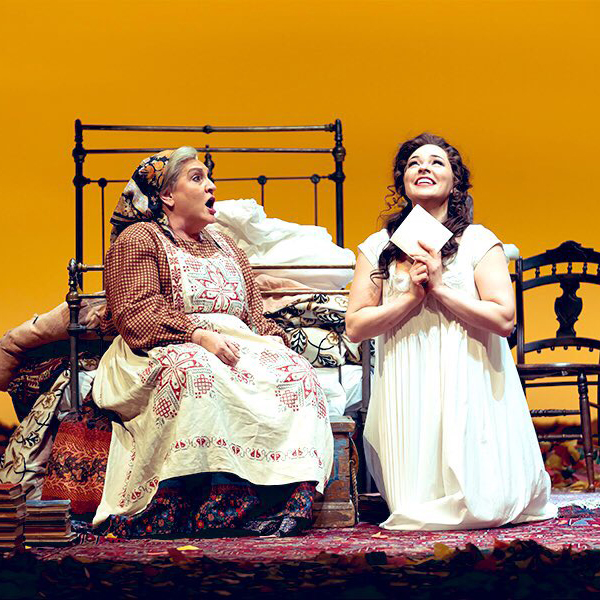
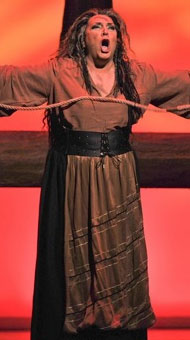
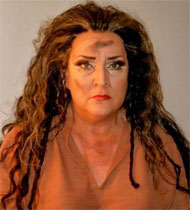
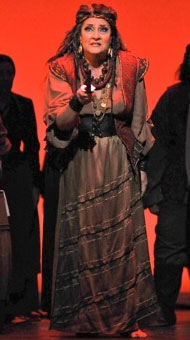
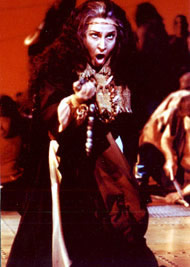
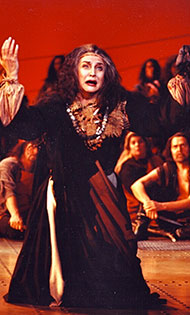
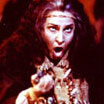
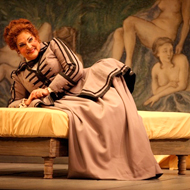
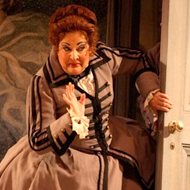
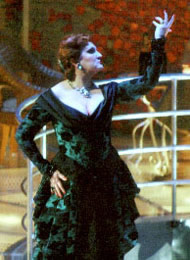
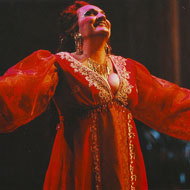
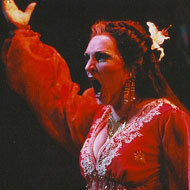
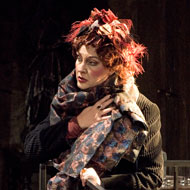
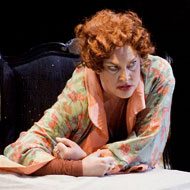
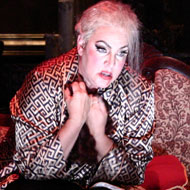
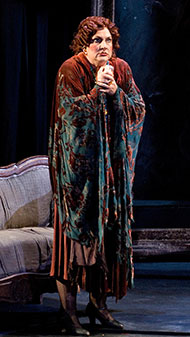
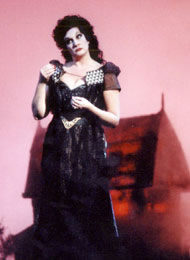
Azucena / Il Trovatore (Verdi)
Fort Worth Opera Production
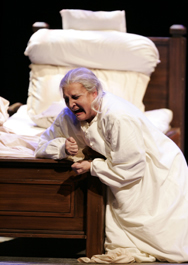
"This production put together impressive, hefty-voiced singers. As the crazed Azucena, mezzo-soprano Victoria Livengood had many memorable moments. Her voice seems to be three distinct insturments: a strong lower register of remarkable clarity; a smooth, flexible middle voice; and a bright trumpet of an upper range that cuts through chorus and orchestra with amazing force. Dramatically it was in the final prison scene, in which she sat trance-like, holding a crumpled blanket to her cheek, gently crooning to it as if her heart would break, that Livengood impressed the most."
- Leonard Eureka, "Il Trovatore - The Voice" (Fort Worth Weekly)
"I had to keep pinching myself Saturday night, to make sure I was actually sitting in Bass Performance Hall and hearing the glorious sounds filling - and I do mean filling - the room. Enrico Caruso famously quipped that the only thing you need for a great Il Trovatore is four of the greatest singers in the world, and you'd be hard pressed to outdo the four Darren Woods has booked for the Fort Worth Opera Festival. This is one of the operatic thrillers of the year. Then there's Victoria Livengood capturing both the sheer weirdness and the maternal warmth of the gypsy Azucena, her potent mezzo including a fearsome chest voice. It's not just that the voices are thrilling per se, but that the singers deploy them so dramatically and expressively. They sing quietly and conspiratorially as well as ferociously and they bring Verdi's tragic figures vividly to life."
- Scott Cantrell, Classical Music Critic (Dallas News, May 22, 2011)
"The Fort Worth Opera gave a powerful demonstration on Saturday night of why Il Trovatore has remained one of the most popular operas down through the years. Verdi's Gothic horror story has lost some of its punch through familiarity, but with the right ingredients -- especially four topnotch singers in the leading roles -- it can send a shiver down the spine once more. The Fort Worth Opera has those ingredients and mixed them well on Saturday night. The Fearsome Four included alto Victoria Livengood as Azucena, who sang her taxing role with strength and ear-pleasing vocalism and her acting was Verdi-capable."
- Olin Chism (Fort Worth Star Telegram, May 22, 2011)
"The real star of this production, however, is the simply awe-inspiring Victoria Livengood in her role as Azucena. I probably could have done the entire review singing her praises. Having recently heard Dolora Zajick give a rousing performance of the role for the Metropolitan Opera, I was incredibly surprised to hear a mezzo-soprano top that performance so soon, and in Fort Worth. The role of Azucena is one that requires the singer to bring out their inner-crazy. It is by no means a dainty, femme-fatale character, because in the end, everyone is simply acting according to Azucena's plan. Ms. Livengood brings out the role like I've never heard. Her ability to utilize her chest-voice and bring out her extended lower range sends the character over the top. The audience almost gets the sensation that two women are singing. The "earthy" quality of the sound not only invokes fear and mystery, it demonstrates the true power of the character. It allows the audience to see the two sides of Azucena – the one telling Manrico she loves him, and the one plotting the continued pain of the Di Luna family. Everytime Ms. Livengood took the stage, you could feel the excitement level rise in the hall. I'm still shouting "Brava!" today." - David Weuste (Everyday Opera, May 23, 2011)
"The women rule the night, as the performance given by Victoria Livengood as Azucena is brilliant. While the role does not have as wide a vocal range as that of Leonora, it makes up for it in stamina - and Livengood has that in spades. In addition to having a magnificent voice, she is easily the best actor of the evening. A remarkable moment for her is in the second act when she recounts the story of her mother's death to the rest of the gypsies; as part of the staging, she is seen to be physically drawing in the crowd. Her control often has the same effect on the audience: everyone seems physically drawn in whenever she sings. Do not miss this production. The vocal fireworks alone make the price of admission worth it. You will not leave disappointed." - John Norine Jr. (Theater Jones.com, May 22, 2011)
"Fans of great singing who make the drive over to Fort Worth can experience a steady flow of wonderful vocal performances, presented with a level of devotion that imbues Verdi's sometimes twisted plot with momentum and credibility. This dream cast includes Mezzo-soprano Victoria Livengood. She owns a dusky, auditorium-filling voice and emphasized the crazed, post-traumatic delusional aspects of the character of Azucena, the old gypsy woman. - Dallas Front Row Critic
"A fine cast of established, first-rate singers has been assembled, and they do a good job of selling this uncompromising creation. Victoria Livengood, as Azucena, is the stuff bad dreams are made of
- in other words, PERFECT! She rules the stage, not only with her haunting, resonant voice, but with her intensity."
- Buffalo News (June 25, 2011)
Other Performances
"Best of the cast was mezzo-soprano Victoria Livengood as Azucena. Her voice was a size larger
than anyone else's, yet only she came close to a clean trill. Her singing and acting radiated intensity.
She riveted attention before singing a note, even through the clanging anvils." Opera News
"I do not remember hearing such an enormous voice in the Discovery Theatre as that of Victoria Livengood.
Also having the most impressive resume among the cast, she demonstrated the above mentioned abundance
of vocality when her voice topped not only the orchestra but the entire men's chorus that was backing her
up. Ms. Livengood is a genuine, natural, fully-qualified Verdian, her pitches accurate, phrasing comfortable
yet dramatic. She maintained a high level of energy in one grueling scene after another while amply
filling the house to the back-row seats."
Anchorage Daily News, Alaska
"As the distraught and avenging gypsy-witch, mezzo-soprano Victoria Livengood, plays her role
with relentless intensity, keeping her huge, grief-crazed eyes thrust on the audience. With the stage designed
to hang partially over the orchestra pit, Livengood brought this already dramatic production to a high pitch."
The Columbian, Oregon
"Livengood's Azucena - all twitching, tortured anguish - lived up to one of her lines in the opera:
"It still raises my hair to think about it." Livengood is a first-rate singing actress; disarming naturalness
of gesture, unexpected shading of phrasing, and something scarily raw in her horror at the murder of her own heart made for a mesmerizing performance."
Willamette Weekly, Oregon
|
|
|
|
|
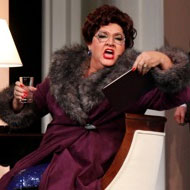
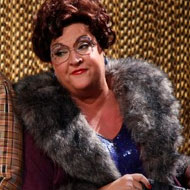
Mrs. Doc / A Quiet Place
(by Leonard Bernstein)
New York City Opera
"The whole cast was strong, especially Victoria Livengood as the loud-mouthed Mrs. Doc, Dinah's co-dependent friend." The New York Times
"The Minor Characters were superbly appropriate. Take the character of Mrs. Doc. Victoria Livengood, a bold mezzo-soprano, was both Horne-esque, and Blythe-esque." New York Chronicle by Jay Nordlinger
"Victoria Livengood gave a colorful performance." Musical America
"Among the supporting roles, Victoria Livengood as Mrs. Doc threatened to steal the show with her acerbic asides delivered in a ringing alto."
The Classical Review
"In general, New York City Opera's performers are stronger singers than actors, though some
acting performances stand out, including Victoria Livengood, who makes a strong impression as a mourner with no time for
insincerities." Backstage
"The cast to a one were excellent. As Mrs. Doc, Victoria LIvengood was delightful and funny."
Berkshire Fine Arts
"The early part of the opera is dominated by veteran mezzo-soprano Victoria Livengood as Dinah's friend, larger than life as the Doctor's wife, never at a loss for a scathing remark." On Stage
"The performances are universally excellent with mezzo soprano Victoria Livengood as a haughty friend of the family." The Hour
|
|
|
|
|
Marquise / La Fille
Du Regiment
Barcelona, Teatro Liceu
Debut
"It was a wonderful cast with great work coming
from the magnificent Victoria Livengood as the Marquise
de Berkenfield. She was perfect for this role."
La Razon, Spain
"Victoria Livengood completed this effective
case as the Marquise de Berkenfield, achieving the
comic character while also showing her human side."
El Mundo, Spain
"The winks continued with the fantastic Victoria
Livengood as the Marquise de Berkenfield, catching
the public by surprise when she sang a few bars
of Rosor."
El Pais, Spain
"Joining the cast was Victoria Livengood, a splendid
Marquise de Berkenfield."
El Punt, Barcelona
"Victoria Livengood played a generous Marquise
who did not hesitate to burst out with the well-known
Roso." Avui, Barcelona
"The same happened with Victoria Livengood, the
Marquise de Berkenfield, when she sang a satirical
Roso. She and Sulpice are the key figures
in a show set in 3 different sceneries."
El Periodico de Catalana
"The great Victoria Livengood was a good replica
of the sophisticated Marquise de Berkenfield."
ABC, Catalana
"Victoria Livengood's Marquise is a real find.
Vocally there's no way to get into the role, but
she brings its limited possibilities into her comfort
zone and magnificently makes the most of it. Stage
presence which certainly recalls Margaret Dumont,
in the service of a more theatrical than musical
character. And with an appropriate gag sung in the
second act, she put the audience in her pocket.
She had a great success." Opera
L
"As the Marquise, mezzo soprano Victoria Livengood
made the most of some wonderfully sultry low passages
- her voice is a lovely one, rich and deep."
Washington Post
"Victoria Livengood threw herself into the role
of the Marquise and her singing had an effective
spark." Baltimore Sun
"Kudos to the mezzo-soprano Victoria Livengood,
whose Margaret Dumont-style histrionics and huge
voice endowed the marquise with great authority
spiced with a dash of impetuosity."
Washington Times
"From the explosive entrance of the Marquise
de Berkenfield, Victoria Livengood is an expressive
and versatile actress and a mezzo soprano who gave
a gala interpretation of the Marquise not only of
character but who can sing to perfection. She is
Wagnerian in volume from her middle voice down to
the weighty lower register."
El Mercurio, Santiago, Chile
"The mezzo soprano, Victoria Livengood imposed
herself with a dark, homogeneous and weighty voice."
La Tercera, Santiago, Chile
"Victoria Livengood was a mezzo of good sound
resources, in which the weight and firmness of her
lower notes are a highlight. Her versatile acting
chops took her character's first act exuberance
into authentic emotional drama in the 2nd Act."
La Segunda, Santiago, Chile
"Victoria Livengood is another de lux singer.
With great know how she gives the role vocal and
acting exuberance which wins you over from the start."
Las Ultimas Noticias, Chile
"Victoria Livengood's Marquise was as buffa as
this role requires. Her entrance during the first
act, coloratura singing included, showed many of
the things this artist has to offer, big voice and
a homogenous register." Opera
Click
|
|
|
|
|
Klytemnestra / Elektra
Taipei National Symphony Orchestra
Family matters: As Klytemnestra in Taipei, Victoria Livengood's dynamic with Elektra was riveting and even descended into a cat fight. In spite of the concert situation, there were some interesting confrontations. The American mezzo-soprano was compelling, visually and aurally, in regal embroidered robe and bejewelled wig.
Opera Magazine, London, May, 2011
Festival de Opera de Las Palmas de Gran Canaria
(Victoria's debut in the role and with this company)
"The mezzo soprano, Victoria Livengood, performs
an amazing Klytemnestra, with the shadow of fear
in her apparent royal majesty and a deep and expressive
voice with sudden high extensions."
La Provincia
"There was a Sensational point of view of the
compelling Klytemnestra of Victoria Livengood, offering
a complete vocal scale, with powerful low notes.
A persuasive wave of sound that she modulates with
extreme manageability, including screaming as well
as frenetic laughter." Le Recensioni
"Victoria Livengood, was an amazing Klytemnestra,
for her heartbreaking voice and stage presence,
more centered in the affirmation of her own hate
than on the remorse that maintains her insomnia."
Opera Actual
|
|
|
|
|
Marcelina / Le Nozze
Di Figaro
Washington National Opera
Reviews:
"Memorable singers, though, go beyond what is
merely required of them in their roles, and on Saturday,
Victoria Livengood was unquestionably memorable!
Her Marcellina made for a striking, rounded portrayal
of a comic character and her powerful voice could
peel paint off the walls." The
Washington Post
"The evening's best surprise was mezzo-soprano
Victoria Livengood as the scheming old cougar, Marcellina.
This is a classic, comic role that demands a fairly
obnoxious performance. Ms. Livengood went this one
better, looking and sounding almost like a brassy
Ethel Merman in Annie Get Your Gun. But she's a
fine actress, too, making her character's abrupt
switch to the good-guys' side completely believable.
It was a great, selfless performance, adding significantly
to the evening's light, humorous tone."
The Washington Times
"The supporting roles were filled with solid
actor-singers, notably Victoria Livengood as a highly
spirited, irresistible Marcellina. She produced
more sheer volume than all the rest put together
and filled that sound with myriad colors, always
rich in communicative force."
The Baltimore Sun
"Livengood is equally effective as the selfish
Marcellina, a character who threatens Susanna's
and Figaro's well-being and who wants Figaro for
herself."
The Washington Examiner
"Dynamic singing and focused acting combined
last night for a very strong opening with a delightful
physical characterization given by Victoria Livengood
as Marcellina." The Blade, Ohio
|
|
|
 |
Herodias / Salome
"Victoria Livengood sang a nicely furious Herodias
in the Met's unveiling of its fifth production of
Salome." Opera News
"When Mattila was not dominating the stage, Victoria
Livengood's Herodias was. Her tall frame and very
well made-up face embodied the imperious princess
and every move she made was well motivated.
Livengood also sang her role powerfully and authoritatively
with great mezzo tone from top to bottom of the
range." Opera List Online
|
|
|
 |
Old Prioress / Dialogues
of the Carmelites
"Vocally and dramatically, the most powerful
performer Friday night was alto Victoria Livengood,
whose nearly overwhelming voice was matched by a
potent dramatic performance as the old prioress."
The Dallas Morning News
"The challenge was met by a majority of the excellent
cast, headed by extraordinary mezzo-soprano Victoria
Livengood as the old prioress. Her enormous honey-coated
voice rattled the rafters in a death scene worthy
of Maria Callas. After this powerhouse performance
that closed the first act, the opening night audience
had no choice but to come back."
Fort Worth Weekly: Stage
"Among the singers, Victoria Livengood, known
to Met audiences, was overwhelming as Mme. de Croissy,
the death scene being stunningly sung and credibly
acted." Compuserve Music Forum
"VICTORIA LIVENGOOD has taken on a new image
with the role of the Old Prioress, I didn't even
recognize her! Ms. Livengood's own Southern accent
completely disappeared for this important portrayal.
Indeed, EVERY word was completely intelligible.
The Old Prioress Death Scene was momentous, as Ms.
Livengood wrenched herself out of the bed to fall
to the floor, writhing in agony, but never giving
in to over-dramatizing. She is now up there in my
books with Crespin, Gorr, and Dunn."
Opera List Online
|
|
|
|
|
Dalila / Samson and
Dalila
Click here to read
"A daughter of the South becomes a diva of the world"
from
The Boston Globe (June 3, 2005)
"Victoria Livengood sang Dalila, impressing the
listener with varied tonal quality allied to deep
imagination, shaping her line with seductive overtones
that drove the drama. She appeared tall and supple
in her burgundy sheath gown, and she looked sensational
and sang beautifully." Opera
News
"In Victoria Livengood, the company found a principal
singer who filled the role with the musical richness
that the score demands, and who taps the ardor and
heroism inherent in the music. Livengood, who was
such a commanding Carmen with Cleveland Opera several
seasons ago, depicted a Dalila of tunnel vision,
a woman who must succeed at her mission. With a
pulsating mezzo-soprano that encompassed the vocal
writing to splendid effect, Livengood vividly evoked
the romantic duplicity in "Mon Coeur s'ouvre a ta
voix" and proved a force of nature when going about
her dastardly deed." Cleveland
Plain Dealer
"Thomasville native and Met star mezzo-soprano
Victoria Livengood, familiar to Triangle audiences
for her steamy portrayal of Carmen in 2001, was
in top form as she took on the role of yet another
sexual predator. Samson was no match for her, sexually,
dramatically or vocally." Classical
Music Journal, NC
"Victoria Livengood's Dalila was both riveting
and commanding as a cross between Theda Bara and
Joan Crawford and her incomparable phrasing and
warmth as reminiscent of Maria Callas's recordings."
Boston Phoenix
|
|
|
|
|
Baroness / Vanessa
"For some reason, the old Baroness gives her daughter
Vanessa the silent treatment, but when Victoria Livengood
did speak, she roared." Musical America
"Also deserving praise is mezzo-soprano Victoria
Livengood as the Baroness. She gives this puzzling yet
key character, who is seen more than she is heard, a
powerful stage presence." The Denver
Post
"The principal cast completes the picture with three-dimensional
acting, marvelous singing and a chemistry that draws
us in from first moment to last. Most impressive was
their concluding quintet. Victoria Livengood did her
best with the cruelly ungrateful role of the Baroness,
cashing in on her rare vocal turns with a powerful mezzo
that could bring more damage to the Opera House's legendary
loose plaster." The Rocky Mountain
News
"If looks could kill, Victoria Livengood as the Baroness
would take home the Grand Prize. Behind the piercing
glare, lives a beautiful smile. In Central City Opera's
magnificent production of Samuel Barber's American Opera,
Vanessa, the smile is never seen. Not until overwhelming
applause when the Baroness resumes her stance of silence
with her granddaughter, Erika, and the orchestra plays
its last note, does the smile appear. With few lines,
and fewer bars to sing, the commanding, demanding presence
of this Baroness nearly steals the show. Behind the
Baroness' mask of a cold shoulder lives mezzo-soprano,
Victoria Livengood. What an honor for Central City to
capture this international Metropolitan Opera star.
The New York Times called her "naturally seductive and
vocally alluring," and I would add that she is "a master
of silent communication with her straight as a ramrod
royal stance, and her icy cold demeanor."
Colorado Backstage
"There's only one person in Samuel Barber's "Vanessa"
who knows all, but she's not talking. That's the Baroness/Grandmother,
marvelously portrayed by Victoria Livengood in the superlative
cast that the CCO has assembled."
The Boulder Camera
"Victoria Livengood uses her powerful mezzo to echo
the Baronness' disappointment." Colorado
Drama
|
|
|
|
|
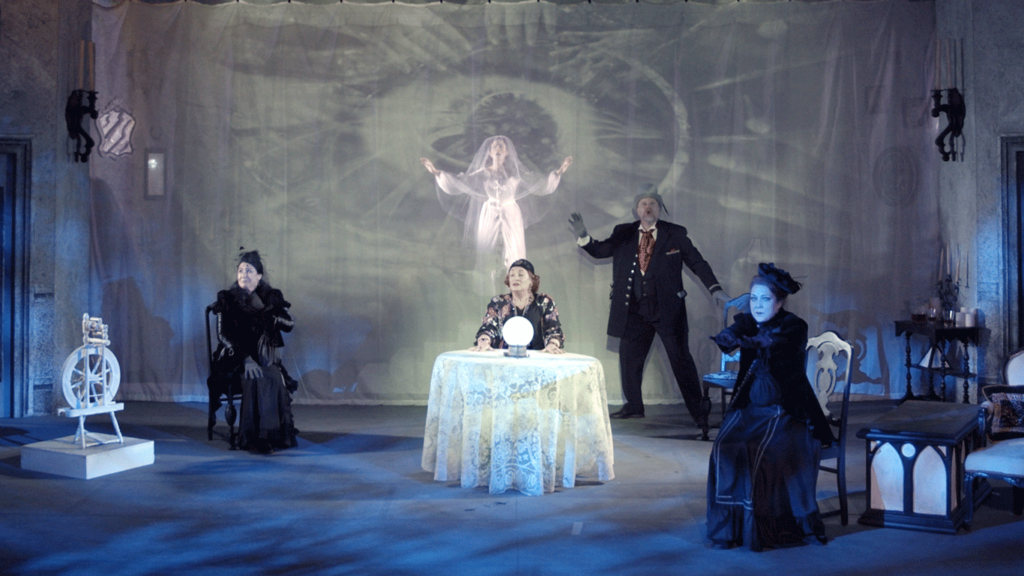
Madame Flora / The Medium
"It is logical that Victoria Livengood dominated
the stage as Madame Flora. The American mezzo has an
exacting range, total comfort of her body and delivers
a hallucinogenic portrait of her final mad scene which
leaves the spectator in a state of shock. Her portrayal
is perfect, in particular for her dedication to project
the English text." Opera International
Magazine
"Posthumous homage to the composer, Menotti, was
given an electrical representation of this lyric drama
by the convincing and sincere Victoria Livengood. She
is a dramatic actress equipped with a contralto voice
with an impressive lower register and is a fascinating
Madame Flora, worthy of praise."
Tribune Bulletin, Cote d'azur, Monaco
"This representation unfolds in a grave mood, strangely
haunted by the memory of the composer himself. The performance
was admirable and poignant and dominated by the fascinating
singer-actress, Victoria Livengood."
Nice-Matin, France
"Victoria Livengood creates a bigger than life impression
as Baba, her approach is like a graduate of the actor's
studio or as one would see in a Tennessee Williams'
play." Chroniques Opera, France
"Victoria Livengood's performance is mysterious,
scholarly employing silences, maintaining a constant
dramatic tension that stretches one towards a feeling
of oppression. She inhabits the true-false role of Madame
Flora brilliantly. She is a formidable mezzo that masters
an entire range of vocal sounds, from murmurs to screams,
from soft hallucinogenic melodies to loud declamations
that could freeze your blood." Scenes
Magazine
"The lead role of Madame Flora was wonderfully portrayed
by Victoria Livengood. The mezzo soprano, who has made
a name for herself above all in the USA as Carmen, seemed
wonderfully at home with the part of the Medium and
gave the drunken character fitting vulgar undertones
in the voice." Opernglas Magazine
"At the center of the drama was a Flora incarnate
portrayed with dark intensity by the authoritative and
superb Victoria Livengood, who was moved to tears by
the final applause. The performance concludes as if
in a trance. Victoria Livengood, rather than entering
into the character of Baba, was possessed by it."
Il Giornale, Italy
"The portrayal of the mezzo soprano, Victoria Livengood,
was nothing short of magisterial. She knew how to heighten
even further the dark hues and somber tones of Menotti's
music, adding her own dramatic engraving stamp to Menotti's
imprint." Dell Umbria, Italy
"Victoria Livengood, rather than entering into the
character of Baba, was possessed and embodied by it
so completely that the performance concluded as if we
were all in a trance." Il Giorno,
Italy
"Mezzo soprano Victoria Livengood, a major Metropolitan
Opera diva, graced the stage for opening night and was
like a force of nature. She was powerful and dominating
as the crude, coarse Medium. She inhabited her role,
it consumed her. Menotti's music was about mood and
setting atmosphere and her big voice had plenty of edge
throughout the often sung dialogue and screaming with
loads of color and dynamic contrasts in her lyrical
moments. The combinations of words were like poetry."
Daily Gazette, NY
|
|
|
|
|
Baba the Turk / The Rake's
Progress
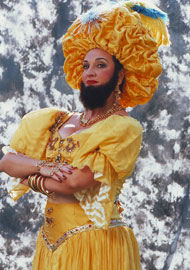
"In the colorful role of the bearded lady, Baba the
Turk, Victoria Livengood returned to The Colon. The
voice of the North American filled the hall with its
multitude of colors to the obvious pleasure of all.
Her participation brought to the production the necessary
quota of humor along with a strong and secure voice.
She justifiably received the most enthusiastic ovation
of the evening." La Nacion, Buenos
Aires
"The largest round of applause was for Victoria Livengood
who presented the role of the bearded lady with the
necessary panache. This mezzo with her gifted and splendid
instrument must also be taken very seriously as an actress.
These are aspects of her talent which she previously
demonstrated on this stage as the chilling Secretary
in the Consul of Menotti." Ambito
Financier, Buenos Aires
"Victoria Livengood as the bearded Baba was extraordinary
and on an equal level with the fantastic Samuel Ramey."
Pagina Doce, Buenos Aires
"North American mezzo Victoria Livengood comically
lit up the scene with a voice of both power and consistent
color." La Prensa, Buenos Aires
"Applause to mezzo-soprano Victoria Livengood, who
as the bearded lady, Baba the Turk, was suitably larger
than life and sultry-hued."
The Globe, Vancouver, BC
"Mezzo-soprano Victoria Livengood, brought power
and outrageousness to Baba the Turk, the bearded-lady
society grand dame." The Sun, Vancouver,
BC
"In a nearly perfect dream production, one cannot
imagine a better Baba the Turk than American mezzo-soprano
Victoria Livengood."
The Westender. Vancouver, BC
"Victoria Livengood's campy and show-stealing Baba
is in good hands as a minx-like girl-boy with a golden
heart in this effervescent production."
The Arts Journal, Vancouver, BC
|
|
|
 |
Giulietta / The Tales Of
Hoffmann
"Victoria Livengood made a convincing Giulietta,
displaying a likable mezzo and attractive presence."
Opera News
"Miss Livengood, in body language and with her huskier,
more sensuous voice, easily becomes one with the seductress
Giulietta." The Washington Times
"As Giulietta, the woman who steals Hoffmann's reflection,
Victoria Livengood produced terrific vocal firepower
and expressive nuance." The Baltimore
Sun
"The trio of heroines vaults this production into
world class. The mezzo-soprano Victoria Livengood, as
the courtesan Giulietta, acted sturdily to her character
type but sang with delicious abandon."
Richmond Times Dispatch
"Victoria Livengood made a convincing Giulietta,
displaying a likeable mezzo and attractive presence."
Opera News Magazine
"Victoria Livengood, with her abundant voice and
measured performance, surprised and astonished the public
with her interpretation of the courtesan Giulietta."
El Tiempo Latino, Spain
|
|
|
 |
Secretary / The Consul
"Victoria Livengood was certainly her equal playing
the bureaucratic formality of the secretary."
Opera Magazine
"Victoria Livengood a memorably odious Secretary."
Opera News
"Newcomer Victoria Livengood showed why she is considered
one of the leading singer-actresses today. She could
head a straight version of the play, and her wonderful
voice complemented her acting superbly."
The Buenos Aires Herald (Argentina)
"Victoria Livengood as the Secretary is an excellent
singer but also a splendid actress. She has a perfect
brazen face: that means she created a masterpiece of
interpretation." La Repubblica ,
Italy
"Special remarks must go to Victoria Livengood in
the part of the Secretary for her dramatic impersonation
and vocal mastery." La Nazione, Italy
|
|
|
 |
Helene / War and Peace
"A real revelation was the Mezzo-soprano Victoria
Livengood."
La Repubblica, Italy
"Victoria Livengood found an edgy expressiveness
in the awful Hélène Bezukhova." The
New Yorker Magazine
"The mezzo-soprano Victoria Livengood was appropriately
catty as his sister Helene, the self-appointed czarina
of Moscow society." The New York
Times
"Mezzo Soprano Victoria Livengood stole every scene
she was in with her large and rich voice, terrific acting
skills and her eye-catching figure."
Opera News Online
"Victoria Livengood was appropriately arch as Pierre
Bezukhov's amoral and mischief-making wife, Helene,
in the Met's new production."
Musical America Magazine
|
|
|
 |
Maddalena / Rigoletto
"The mezzo-soprano Victoria Livengood was a naturally
seductive and vocally alluring Maddalena."
The New York Times
|
|
|
 |
Prince Orlovsky / Die Fledermaus
"The Prince Orlovsky of the mezzo Victoria Livengood
was adequately brought to life in the personage."
Critica de Opera, Chile
"In the ambiguous and little agreeable role of Prince
Orlovsky – the mezzo Victoria Livengood displayed a
natural stage sense and a timbre of exceptional quality
in the ‘Chancun a son gout'." Critica
de Opera, Chile
"Victoria Livengood's Prince was idiomatic, perfectly
sung, and vividly portrayed. She sang the role
with great fluency and a full, rich voice."
Opera News Online
|
|
|
 |
Marina / Boris Godunov
"Mezzo-soprano Victoria Livengood was vocally brilliant
as Princess Marina."
Opera Canada
"As Marina , Victoria Livengood sang with welcome
vocal power and intensity of expression."
The Washington Post
"Victoria Livengood's Marina is a preening peacock
and is done with great relish, style and vocals."
Le Concertographe
|
|
|
 |
Ortrud / Lohengrin
"An exemplary cast was vocally dominated by the incredible
Ortrud of Victoria Livengood. She has a rich, full chest
voice and with the power of her high voice she could
straighten the Tower of Pisa ." Il
Tempo, Italy
"The mezzo Victoria Livengood exuded malevolence
as Ortrud and was especially impressive in her final
testing outburst!" The Telegraph,
London
"The dark round voice of Victoria Livengood along
with her strong and magnetic personality painted the
horrors of the demonic world of Ortrud perfectly."
Opera Magazine, Spain
"The highest level of performing came from a Spoleto
Festival favorite, Victoria Livengood, who was a precise
and strong Ortrud and she owns the role dramatically."
Corriere, Italy
"The vocal instrument of the largest capacity and
highest quality is that of Victoria Livengood."
La Stampa, Italy
"When we talk about the scene on stage, the biggest
impact was made by Victoria Livengood, an Ortrud as
wicked and slimy as Lady Macbeth."
Il Giornale, Italy
"The most positive impression was made by the full
of temperament, Victoria Livengood, as Ortrud."
Corriere, Italy
"Best of the cast was the Lady Macbeth type Ortrud
of Victoria Livengood, who dominated with nails and
eroticism." Il Giorno, Italy
"The wicked Ortrud of Victoria Livengood deserves
much applause for both her Ortrud this season and last
year's most memorable title role in Menotti's Medium."
Il Messaggero, Italy
"Victoria Livengood had the voice most full of all
the right colors for Wagner." Gazzetta
del Sud, Italy
|
|
|
|
|
Lampito / Lysistrata (World
Premiere)
"Victoria Livengood exulted in the vaudeville-ish
"foreign" accent that Adamo bestowed on Lampito, wife
of the Spartan general." Opera News
Magazine
"Victoria Livengood (Lampito) stood out among the
women." New York Times
"In the Houston Opera Production, Victoria Livengood
was excellent."
New Yorker Magazine
"The 17-member cast sang vibrantly and eloquently.
Mezzo-soprano Victoria Livengood was all Amazon in attitude,
height and voice as Lampito, leader of the Spartan women."
Houston Chronicle
"Victoria Livengood upheld the vocal honors of Sparta
as the general Leonides' wife Lampito." Houston Grand
Opera assembled a hot cast and Ms. Livengood was among
the standouts." MusicalAmerica.com
"Houston Grand Opera gave Lysistrata a first-class
sendoff, fielding a cast of excellent singers who seized
the vocal and comic elements with relish. Of Lysia's
fellow warriors, Victoria Livengood was a hoot with
her Zsa Zsa Gabor accent as Lampito, the Amazon Spartan."
South Florida Sun-Sentinel
"Playing the Spartan women's leader, Lampito, Victoria
Livengood commands the scene with a big, lustrous mezzo
and campy Elmer Fudd accent."
Dallas Morning News
"HGO has assembled a sterling cast. Lampito, is powered
by mezzo-soprano Victoria Livengood's huge freight locomotive
of a voice." San Antonio Express
"As Lampito, wife of the Spartan General, Mezzo-soprano
Victoria Livengood blasted the assemblage with sheer
vocal power and regal bearing." College
Station Eagle
‘The excellent cast also included two powerful mezzos,
Myrna Paris, as a cohort of Lysistrata, and Victoria
Livengood, as the wife of the Spartan general Leonidas."
Financial Times
"Victoria Livengood was the real deal - a big, well-controlled
voice and a strongly sexy stage presence."
Opera List Online
|
|
|
|
|
Cristina / La Senorita
Cristina (World Premiere)
"The composer was well served by a fine cast. The
superb Victoria Livengood, was an imposing Cristina,
both physically and vocally." Opera
Now Magazine
"From the magnificent work by the singers in general,
the protagonist Victoria Livengood stands out. This
is a mezzo with an extended range and beautiful voice
who took on with ease three very important and difficult
scenes with an extraordinary richness of colors."
Opera Actual Magazine, Spain
"Victoria Livengood is a convincing Cristina of powerful
presence and abundant resources who lavishly succeeded
from the first moment as the apparition without ever
losing her ghost like condition to a fascinating result.
She provided an interpretation full of contrast and
intensity with a firmness of conviction."
El Mundo, Spain
"The character of Cristina, personified by the mezzo
soprano Victoria Livengood, is brilliant as both a singer
and an actress of merit and magnificent in every detail."
ABC Magazine, Spain
"The audience came seeking wealth and Victoria Livengood
gave them their treasure. Her responsibility for bringing
this master work to reality has been splendid. Her performance
reached a truly high level and she lived up to the impressive
credits in her biography." La Razon,
Spain
"Of special value was Victoria Livengood as the carnal
ghost, Cristina, who displayed great conviction and
an exemplary delivery." Diario, Spain
"Special mention must go to the stand out in the
cast, on the night of her debut, American mezzo soprano
Victoria Livengood as Cristina, a woman thirsty for
love and blood." Actualidad, Spain
"This world premiere of La Senorita Cristina was
a triumphant occasion for the composer and for the American
mezzo, Victoria Livengood. She was simply magnificent.
It is a rare pleasure to hear such a gorgeous voice
combined with an outstanding stage presence. Her lush,
rich and powerful mezzo rang out and filled the Teatro
Real with a resonant sound that I have not heard since
the opening of the theater three years ago. Ms. Livengood
was awarded a thunderous ovation by an audience so wrapped
up in her performance, that one never heard a single
sound during the evening." La Salle
University Magazine, Spain
"For the singers, this music is very complicated
but Victoria Livengood in the title role of Cristina
was at a very high level and responded to the task at
hand with generosity and an undeniable quality of the
highest artistry."
El Diario Vasco/ San Sebastian, Spain
"A name to remember is that of Victoria Livengood,
who as the protagonist was fantastic and brilliant in
every scene." La Nueva Espana, Spain
"In a very strong cast, special emphasis must go
to Victoria Livengood for her intense portrayal of Cristina
as the ultimate victim, hoping to obtain love and passion.
Cultura, Spain
"The vocal cast was spotless headed by the excellent
mezzo soprano Victoria Livengood in the title role who
gave life to the protagonist." Ritmo
Spain
"In the title role, Livengood's powerful voice and
stage presence easily projected over De Pablo's enormous
orchestra, as she fully inhabited the title role of
Senorita Cristina." Opera Canada
Magazine
"Victoria Livengood demonstrated the highest vocal
quality. Dramatically, she was larger than life and
totally fascinating. She is a perfect modern artist
with a Diva type persona as the figure Cristina and
one could imagine she would be the perfect Kundry."
Das Opernglas Magazine, Germany
"The American Mezzo, Victoria Livengood, possesses
and emits a full and robust voice full of color and
dramatic intent." Opera International
Magazine
"Victoria Livengood portrayed in splendid form the
title role. She overcame the difficulty of the Spanish
diction and exhibited a voice of abundant qualities."
La Musica Magazine
"The vocal cast was first rate, lead by the magnificent
dramatic mezzo and contemporary music specialist, Victoria
Livengood, who possesses a splendid voice."
Mundo Classico Magazine
|
|
|
 |
Sonetka / Lady Macbeth
of Mtsensk
"Victoria Livengood reveled in the earthy corruption
of the seductive convict, Sonetka."
British Opera Magazine
"Victoria Livengood, as Sergei's final conquest,
showed a rich mezzo well able to fill the Met's large
auditorium." The Winston-Salem Journal
|
|
|
 |
Gertrude / Hamlet
"Victoria Livengood's Gertrude was richly persuasive
both in strong, focused mezzo and in her volatile yet
meaningful exchanges with Hamlet."
Miami Herald
"As Gertrude, Victoria Livengood used her solid,
penetrating mezzo tellingly, notable in the ‘Toi, partir'
aria." Fort Lauderdale News/Sun-Sentinel
|
|
|
 |
Sesto / La Clemenza di
Tito
"As Sesto, debutante Victoria Livengood is nothing
short of a revelation."
Nice-Matin (France)
"The pants role of Sesto was remarkably portrayed
by Victoria Livengood."
Nice-Journale (France)
|
|
|
 |
Laura / Luisa Miller
"Mezzo-soprano Victoria Livengood, as Laura, produced
a lovely dark sonority, even and well-supported."
The New York Times
|
|
|
 |
Beauty / Beauty and the
Beast (American Premiere)
"The part of Beauty was sung by Victoria Livengood,
listed as mezzo-soprano, but with a soaring full lyric
range and a captivating warmth of spirit reminiscent
of Sheri Greenwald." San Francisco
Chronicle
"Victoria Livengood, a mezzo with pure, candid tones,
was a touching Beauty."
The New Yorker
"Victoria Livengood's vocal projection was as virtuous
as her characterization."
The Chicago Tribune
"Victoria Livengood as Beauty lived up to her delicate
use of a fine, full-toned mezzo."
The London Times (England)
"Victoria Livengood's Beauty is sung and acted with
panache. Livengood's powerful, sweet mezzo-soprano is
a consistent delight, and her diction is excellent."
The Riverfront Times
"Mezzo-soprano Victoria Livengood sang the title
role with a big, vibrant, well-projected tone and gave
a poignantly dramatic portrayal."
The Houston Post
|
|
|
|
|
|
|
|